
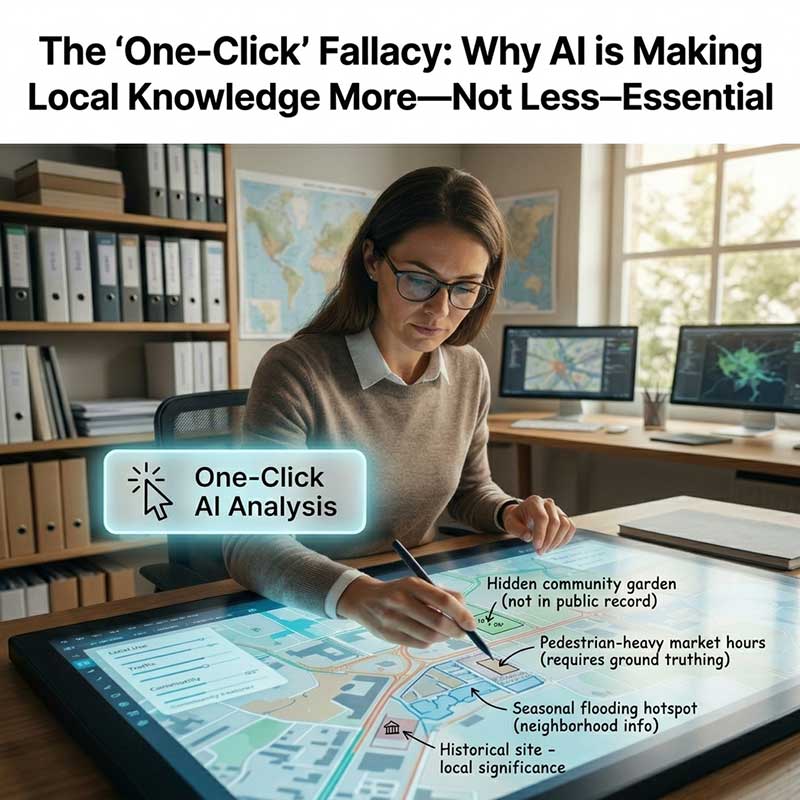

The "One-Click" Fallacy: Why AI is Making Local Knowledge More—Not Less—Essential
As we navigate the middle of 2026, the corporate world has largely moved past the "peak hype" of artificial intelligence and into the more sober "utility phase." In the realm of site selection and economic development, the prevailing narrative remains seductive: that we are entering an era of "one-click" site selection, where a sufficiently advanced algorithm can ingest global datasets and spit out the perfect GPS coordinates for a $2 billion semiconductor plant without a human ever leaving their desk.
This perspective is not just optimistic; it is fundamentally flawed. While AI is undeniably transforming the industry, its greatest impact isn't in automating the search—it’s in exposing the critical gap between global data and local reality.
The Illusion of Digital Completeness
The most common misconception in 2026 is that "everything is online." Modern site selection platforms often market themselves as all-seeing oracles. However, as any seasoned practitioner knows, the most viable industrial sites are rarely fully "cataloged" in standardized national databases.
Generic AI models excel at analyzing structured, digitized information—such as tax rates, census demographics, and highway proximity. But they are notoriously poor at capturing the "messy" qualitative data that actually determines a project’s success:
- The true "intent" of a local zoning board.
- The real-time, unadvertised capacity of a utility substation.
- The political appetite for a specific type of industry.
When companies rely solely on broad-market AI, they risk what we call "Unwarranted Confidence." The AI provides a clean, ranked list, but it is optimized within a distorted, incomplete universe. It chooses the "best" of what it can see, ignoring the superior options that require a local handshake or a deep dive into an agency's specific strategic plan.
The Positive: Levelling the Knowledge Playing Field
Despite these risks, the positive impact of AI on Economic Development Organizations (EDOs) is profound, provided the tool is specialized. For decades, small-to mid-sized agencies struggled to compete with "tier-one" cities because they lacked the marketing budget to keep their unique value propositions in front of site selectors.
AI is changing this by turning static websites into interactive, intelligent experiences. When an EDO’s specific institutional knowledge—its unique grants, its specific workforce training partnerships, its idiosyncratic permitting timelines—is made queryable through specialized interfaces, the "information asymmetry" that favored large cities begins to dissolve.
This is where the shift toward Specialized LLM's becomes instrumental. Our recent analysis of site selection trends revealed that the most successful projects of 2025 were not found through generic search engines, but through tools that bridge the gap between corporate intent and agency-specific data.
The Negative: The Risk of Algorithmic Homogenization
The danger here is that if every corporation uses the same three or four AI platforms for their preliminary screening, we will see an era of Strategic Homogenization. If every EV battery manufacturer uses the same algorithm, they will all be funneled toward the same five "perfect" sites.
This creates artificial demand pressure, drives up land prices, and ignores the untapped potential of "Second-Tier" sites that an AI might flag as "risky" simply because the data is less standardized.
The result? A "race to the middle" where corporations miss out on unique competitive advantages because they outsourced their critical thinking to a consensus-driven model.
The Impact: From "Search" to "Validation"
The overall impact of AI over the coming years will not be the replacement of the site selection consultant or the Economic Developer. Instead, it will shift their roles from Information Gatherers to Context Providers.
The future belongs to a hybrid model. AI will handle the quantitative heavy lifting—filtering 5,000 possibilities down to 50 based on rigid criteria. But the final "shortlist to one" will be driven by the human ability to verify the AI's assumptions against local nuances.
Conclusion: The Value of the Proprietary Chatbot
As we look toward 2027 and beyond, the winners in the economic development space will be those who treat their data as a proprietary asset rather than a public commodity.
How do you see the balance between AI-driven efficiency and local human intuition shifting in your specific industry over the next few years?