
The Industrial Renaissance: Why Brownfields Are the Data Center Industry’s True New Frontier
In the race to build the infrastructure powering the AI revolution, the prevailing wisdom has long been that "Greenfield is Gold." Starting with a pristine, undeveloped parcel of land seems logical: it offers a blank canvas for bespoke designs, optimized cooling for high-density clusters, and an absence of historical soil liabilities.
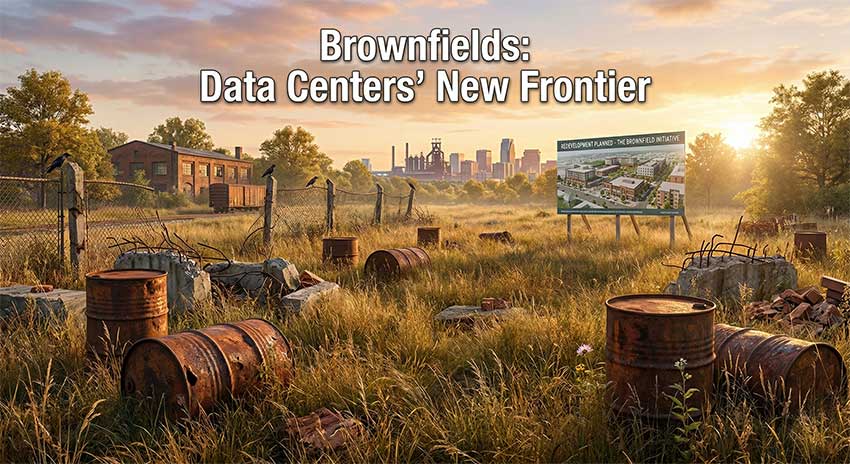
However, as we navigate 2026, this Greenfield-first mentality is encountering unexpected friction. With large parcel land prices increasing by 23% year-over-year and grid connection wait times stretching into the next decade, the industry is approaching a strategic bottleneck. A contrarian, yet increasingly pragmatic, approach is emerging: looking backward to our industrial past to accelerate our digital future. Brownfields—the retired power plants, former warehouses, and abandoned factories of yesteryear—are proving to be the perfect high-speed lane for the AI era.
The Pace of Pristine vs. Practical
Greenfield development is undeniably appealing in its simplicity. Yet, simplicity rarely equates to speed in the current market. Standard data center builds now demand capital upwards of $12 million per megawatt (MW), with AI-ready facilities exceeding $20 million per MW. But the highest cost is time.
A typical Greenfield project can take 7 years from site selection to full operation, heavily bottlenecked by permitting, environmental assessments of undisturbed ecosystems, and agonizing waits for high-voltage transmission lines. In an industry dictated by rapid silicon cycles, waiting half a decade for a substation is a significant competitive liability.
The Power Paradox and "Bring Your Own Generation"
Counterintuitively, legacy industrial sites often provide a more "ShovelReady" environment for heavy AI workloads. These sites were originally engineered for immense, high-voltage power. Many already possess the legacy substations and high-capacity natural gas interconnections that hyperscalers are currently fighting to secure.
As power grids strain, the industry is undergoing a fundamental shift toward "Bring Your Own Generation" (BYOG). Brownfields are uniquely suited to become independent "Power Islands," supporting natural gas microgrids or serving as the frontier for Small Modular Reactors (SMR’s). For example, projects like the TerraPower Natrium reactor in Wyoming—built on a former coal site—demonstrate how pre-existing industrial zoning and community acceptance pave the way for next-generation baseload power.
Unearthing Value Through Intelligent Site Selection
The challenge, naturally, lies in the execution. How does a developer efficiently separate a viable Brownfield from a permanent liability?
Because navigating the zoning laws, water rights, and utility capacities of legacy sites is notoriously complex, using AI specifically trained on the websites and data of participating Economic Development agencies can fundamentally shorten the timeline. Instead of spending months untangling municipal red tape, site selectors can directly query the AI to uncover which local agencies are aggressively incentivizing adaptive reuse, or which specific sites possess the "Grid-Interactive" capabilities needed to feed excess power back to the community. It bridges the gap between historical land data and modern deployment speed.
The Clean Usage Dividend
The transition from heavy industry to digital infrastructure offers a profound social dividend. Take regions like Alberta, Canada, where the 2026 "Bring Your Own Energy" strategy is enabling massive 1.4 GW data center campuses on former industrial land.
Repurposing these sites transforms community blights into massive tax revenue generators without the localized pollution, noise, or strain on municipal budgets typically associated with heavy manufacturing. It replaces shuttered coal plants with carbon-free or highly efficient "new" energy, preserving the local tax base and creating high-skill technical jobs. As the adage goes:
"The greenest building is the one that doesn't require a new road or the loss of farmland to exist."
As we look toward 2030, the organizations that thrive will recognize that the "pristine" choice isn't necessarily the optimal one. By utilizing intelligent, localized data platforms to navigate the complexities of legacy sites, forward-thinking developers are turning the industrial footprints of the past into the foundation of the AI era.